Centella Asiatica: Breaking Down the Actives
Centella asiatica shows up on nearly every 'soothing' product label, but the ingredient list rarely says which of its active compounds are actually present — and that's the detail that decides whether a centella product does much at all.
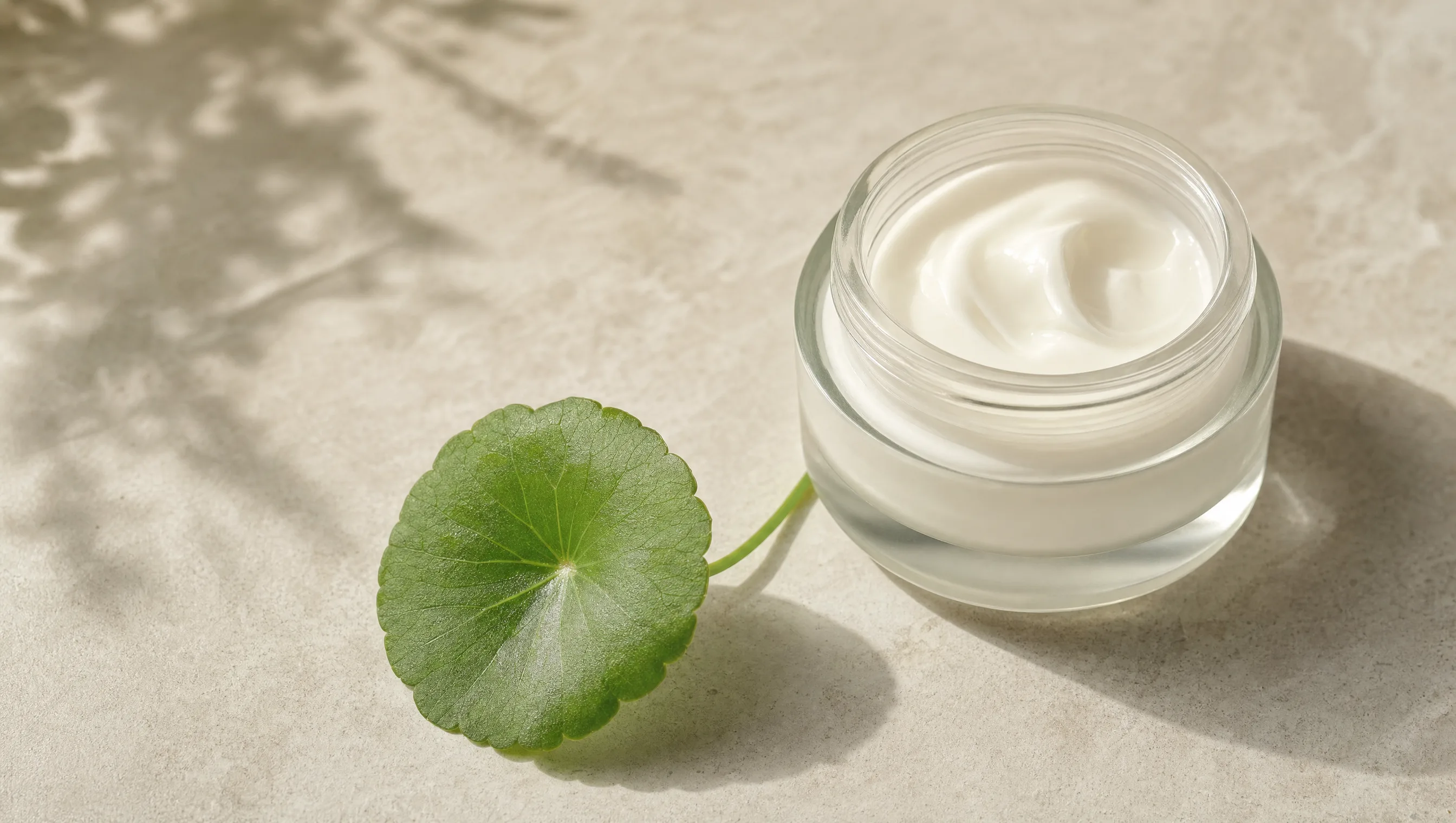
Centella asiatica — also known as Gotu Kola, tiger grass, or cica — has become a staple of soothing skincare, propelled largely by K-beauty and now sold everywhere from luxury serums to supermarket own-brand. The problem is that “centella” on an ingredient list doesn’t tell you much on its own. What matters is which of its active compounds are actually present, at what concentration, and in what form — and most labels don’t say.
What the plant actually contains
Centella asiatica is a herbaceous plant native to tropical and subtropical Asia, long used in traditional medicine, particularly in India and Southeast Asia. It contains a range of bioactive compounds, but four triterpenoid derivatives carry most of the research: madecassoside and asiaticoside (the glycoside forms), and madecassic acid and asiatic acid (their sugar-free, more lipophilic counterparts). Madecassoside has the strongest evidence behind it — reasonable support for reducing the appearance of inflammation, supporting collagen synthesis, and accelerating wound healing. Asiaticoside is often studied alongside it, with the two appearing to work synergistically; it also shows some antioxidant activity. The acid forms carry similar but generally thinner evidence for the same effects.
Why the extraction method is the detail that matters
A product listing “Centella Asiatica Extract” could mean almost anything — high or low concentrations of the active triterpenoids, different ratios of the four key compounds, or a whole-plant extract carrying additional components with no clear evidence behind them. The most studied form is TECA (Titrated Extract of Centella Asiatica), a standardised extract with a defined ratio — roughly 40% asiaticoside, 30% madecassoside, 30% asiatic acid, with madecassic acid making up the remainder. Standardisation is what allows consistent study results, which is why TECA has more research behind it than generic centella extract. Some products instead use isolated madecassoside or asiaticoside for precise dosing, which loses whatever synergistic effect the combined compounds might offer; others use unstandardised whole-plant extracts, where the actual active content is often unknown.
What the evidence actually supports
The strongest evidence for centella, by a clear margin, comes from wound-healing research — active compounds appear to stimulate fibroblast activity, increase collagen production, and speed tissue repair. That translates reasonably well into skincare applications: post-procedure recovery, general barrier repair, and calming skin after irritation.
Anti-inflammatory effects are also well supported, with centella actives reducing inflammatory markers in both cell studies and some clinical research — the basis for its reputation as a soothing ingredient for redness and reactive skin. Collagen stimulation has some support too, from in vitro work and a smaller number of clinical studies, though the anti-ageing case is considerably less documented than the wound-healing one — treat “centella for wrinkles” as a much weaker claim than “centella for irritated skin.” Antioxidant activity shows up reliably in lab studies, but whether that translates into meaningful protection from topical application in everyday use is genuinely less clear.
Who tends to benefit
Centella is a reasonable choice for sensitive or reactive skin, where its soothing properties can help calm the appearance of inflammation, and for post-procedure skin recovering from peels, lasers, or similar treatments. It’s also useful for skin recovering from over-exfoliation or a product reaction, and for rosacea-prone skin, where it may help reduce baseline inflammation, though it isn’t a rosacea treatment in its own right. People using genuinely irritating actives — retinoids or exfoliating acids — sometimes layer centella specifically to offset the irritation. A stressed, inflamed barrier often carries a disrupted skin microbiome alongside it, which is part of why calming ingredients like this tend to matter beyond the surface-level redness.
Where it does less: it isn’t a meaningful anti-ageing treatment on its own — retinoids have far stronger evidence for visible wrinkle reduction — it isn’t a primary acne treatment (though its anti-inflammatory effect may help incidentally), and it does little for pigmentation.
Using it in practice
Centella turns up across formats — serums generally carry the highest concentrations of active compounds, moisturisers work for daily maintenance, sheet masks and spot treatments suit occasional or targeted use, and thicker “cica balms” lean into barrier repair. It’s compatible with most other ingredients: hyaluronic acid for hydration plus soothing, niacinamide for barrier support, retinoids (where it can help offset irritation), and AHAs/BHAs for post-exfoliation calming.
When choosing a product, look past the word “cica” on the label — the trend means plenty of products use the term for appeal with only a token amount of actual centella. Better signals are a standardised extract (TECA or a named ratio), specific compounds named on the ingredient list (madecassoside, asiaticoside), a reasonably high position in the ingredient list, and complementary soothing ingredients like panthenol or allantoin. Red flags run the other way: centella buried near the bottom of a long ingredient list, no specificity about the extract type, or a product otherwise loaded with fragrance or other irritants that undercut the soothing purpose entirely.
Centella itself isn’t an expensive ingredient to source, so a high price tag doesn’t reliably indicate a more effective formulation — judge on extraction quality, concentration, and the rest of the formula rather than brand prestige.
Common questions
Is “cica” just marketing, or does it mean something? Both, depending on the product. Genuine cica products contain meaningful centella concentrations as a primary active; plenty of others use the name for trend appeal with minimal actual centella. Check the ingredient list, not the packaging copy.
Does centella help with acne? Not directly — it isn’t a primary acne treatment — but its anti-inflammatory action may take some of the edge off irritated, inflamed breakouts as a supporting ingredient.
Can centella replace a retinoid for anti-ageing? No. The wrinkle-reduction evidence for retinoids is far more established; centella’s collagen-stimulation evidence is real but considerably thinner, and it works better as a soothing complement than an anti-ageing lead.
Is TECA worth seeking out specifically? If you want the most evidence-backed version of this ingredient, yes — TECA’s standardisation is what most of the clinical research is actually based on, so it’s a reasonable thing to look for on a label.
The bottom line
Centella asiatica is a genuinely useful ingredient with solid evidence behind its soothing, anti-inflammatory, and wound-healing properties, and it’s particularly worth having in a routine for sensitive, irritated, or reactive skin. What it isn’t is a standalone anti-ageing treatment or an acne or pigmentation fix. Not all centella products are equal, either — a standardised extract with documented active content will reliably outperform a vague “centella extract” listed low on the ingredient panel. Use it for what the evidence actually supports — calming and repair — and treat anything more as marketing rather than formulation.