The pH Rules: Why Acidity Makes or Breaks Your Actives
The same active ingredient can work brilliantly or do almost nothing depending on the pH it's formulated at — a distinction most product labels never mention.
Two vitamin C serums can list the exact same concentration on the label and behave completely differently on skin. The difference usually isn’t the ingredient — it’s the pH the formula sits at, a variable most brands never mention and most shoppers never think to ask about.
A quick primer
The pH scale runs from 0 to 14, with 7 as neutral. Below 7 is acidic, above 7 is alkaline, and because the scale is logarithmic, each whole step represents a tenfold change in acidity — pH 4 isn’t slightly more acidic than pH 5, it’s ten times more so.
Healthy skin sits slightly acidic, typically pH 4.5–5.5. This “acid mantle” helps hold the skin barrier together and influences which microorganisms can survive on the surface, which is part of why pH isn’t just a formulation detail — it’s the environment your skincare is either working with or against.
Why it matters for actives specifically
Apply an ingredient outside its optimal pH and a few things can go wrong. It may simply fail to penetrate, sitting on the surface rather than reaching where it needs to act. It may be chemically inactive in that form, present but not doing anything. Some ingredients degrade faster outside their ideal range, so a bottle that’s fine on day one can be doing much less by day sixty. And products applied far from skin’s natural pH can disrupt the acid mantle and provoke sensitivity that has nothing to do with the active ingredient itself.
Vitamin C: the clearest example
L-ascorbic acid — pure vitamin C — is the textbook case for pH-dependent performance. For it to penetrate skin effectively, the formula needs to sit at roughly pH 3.5 or below, where the molecule stays uncharged and lipophilic enough to pass through the stratum corneum. Push the pH higher and the molecule becomes ionised and struggles to get in at all — a vitamin C serum at pH 5 or 6 isn’t delivering the same benefit as one properly formulated at pH 2.5–3.5, even at an identical percentage on the label.
That’s also why L-ascorbic acid serums tend to sting or tingle slightly: they need to be quite acidic to work, and that acidity is exactly what makes them more irritating for sensitive skin than gentler vitamin C derivatives.
AHAs and BHAs follow similar rules, with a twist
AHAs — glycolic, lactic, mandelic — perform best around pH 3–4. Drop below pH 3 and efficacy climbs further, but so does irritation potential; push above pH 4 and efficacy falls off noticeably. The relevant concept here is “free acid value”: at any given pH, only a portion of the acid sits in its active, penetrating form, and a higher pH means more of it has been neutralised into something that isn’t doing much. So when a product markets a higher-pH AHA as “gentle,” that’s often true, but the trade-off is real — it may be milder specifically because it’s less effective.
Salicylic acid (the main BHA) works in the same pH 3–4 range but has an extra advantage: it’s oil-soluble, so it can follow sebum into pores in a way water-soluble AHAs can’t.
Retinoids, niacinamide, and peptides — where pH matters less
Retinoids are considerably less pH-sensitive for penetration, working across a broad range, which makes them easier to combine with other actives. Their real formulation challenge is stability against oxidation and light, not pH.
Niacinamide is stable and effective across roughly pH 5–7, which is a big part of why it turns up in so many products — it’s easy to formulate and rarely creates compatibility problems.
Most peptides perform best in a similar neutral-to-slightly-acidic range, pH 5–7. Strongly acidic conditions can break peptide bonds, which is a reasonable argument for not applying a low-pH acid and a peptide serum back to back in the same step — not because they “cancel out” instantly, but because their ideal chemical environments genuinely differ.
Does layering order actually matter?
When products of different pH are layered, something has to give. Applied immediately on top of each other, the mixture settles somewhere between the two pH values, and neither product ends up performing at its intended pH. Given time to absorb first, skin’s own buffering capacity takes over and gradually pulls the surface back toward its natural pH — which is the basis for the oft-repeated advice to wait 15–20 minutes between pH-sensitive products. That advice has real chemistry behind it, though how much practical difference it makes in everyday use is genuinely debated rather than settled.
A reasonable approach in practice: apply the most pH-sensitive product first — vitamin C or an acid — to clean, dry skin, give it a few minutes, then layer less pH-sensitive products on top. For a fuller sequencing framework, see the layering guide.
Cleansers, toners, and the acid mantle
Traditional bar soap sits at pH 9–10, well into alkaline territory, and disrupts the acid mantle on contact — which is why most modern cleansers are formulated closer to pH 4.5–6.5. A high-pH cleanser can leave skin feeling tight and temporarily impair barrier function, so for most people a low-pH or pH-balanced cleanser is the safer default. Skin does buffer and recover, though, so an occasional high-pH product isn’t the issue — it’s repeated, prolonged alkaline exposure that causes problems.
Some toners are formulated specifically to lower skin’s pH after cleansing, ahead of an acid treatment. Whether that step earns a place in your routine depends on your cleanser’s pH and how quickly your own skin re-equilibrates — for many people it’s a genuinely optional extra, and for those using a higher-pH cleanser or chasing maximum efficacy from vitamin C or AHAs, it can help.
Working it out without a lab
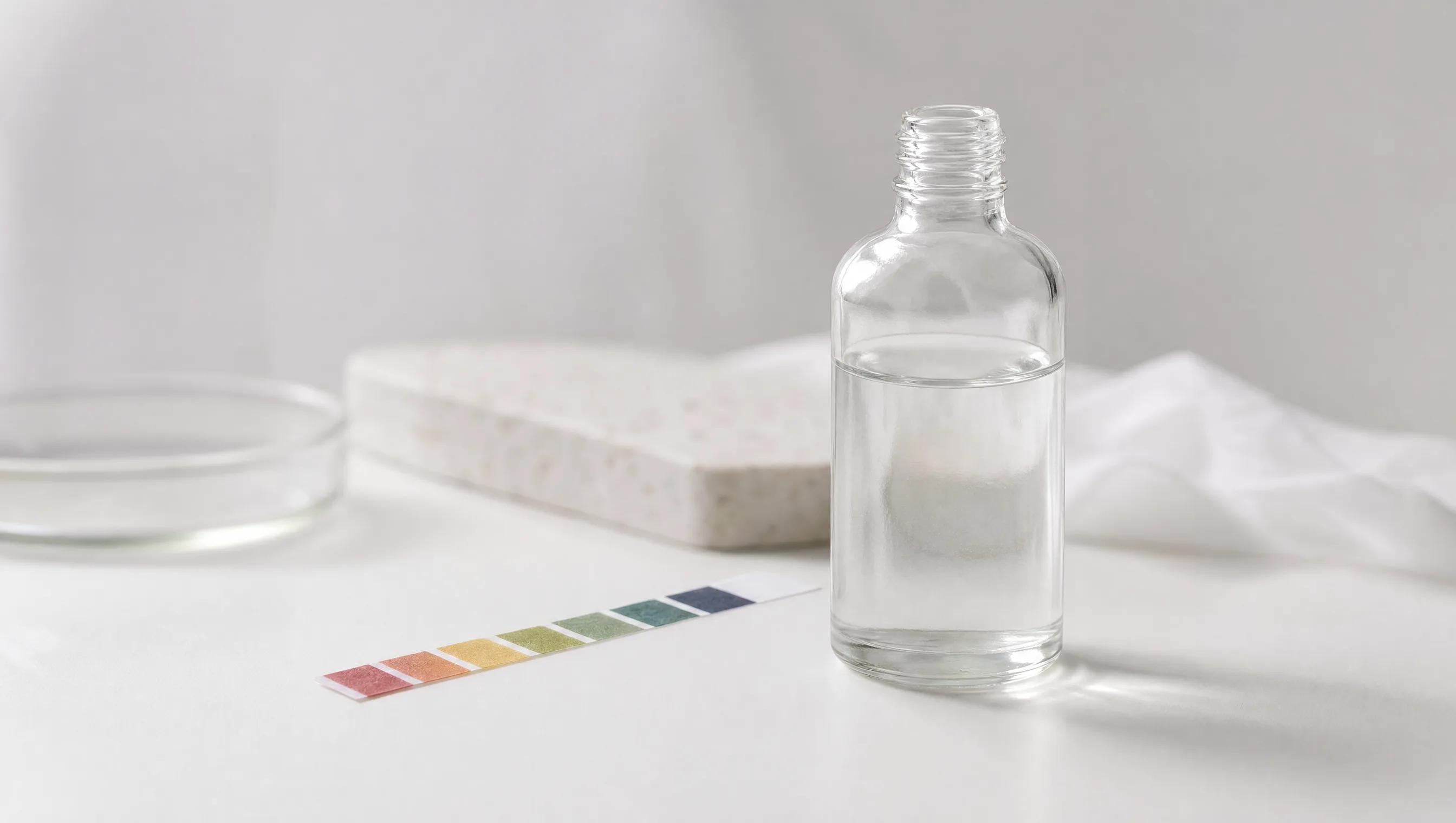
Brands occasionally disclose pH directly, and third-party reviews sometimes measure it independently. Failing that, a few reasonable inferences: an L-ascorbic acid serum needs to sit at pH 3.5 or below to be doing much; AHA and BHA products need roughly pH 3–4 for meaningful exfoliation; noticeable tingling or stinging usually signals something acidic; a slippery or soapy feel usually signals something alkaline. pH testing strips can give you an approximate reading if you want to check for yourself, though accuracy varies with the formula being tested.
The buffering reality
Skin isn’t a passive surface waiting to be acted on — it actively defends its own pH. A pH 3 product doesn’t turn your skin pH 3; your skin’s chemistry pushes back toward its own equilibrium fairly quickly. That buffering is why skincare, even at genuinely low pH, doesn’t behave like pouring acid onto a surface, and it’s also why the difference between, say, pH 3.0 and pH 3.5 in a formula — measurable in a lab — may matter less in practice than it looks on paper.
Common questions
Do I need pH strips to check my routine is working? Not usually. For most people, noticing whether a product stings (likely acidic) or feels slippery (likely alkaline) is enough of a signal. Strips are useful if you specifically want to confirm a vitamin C or acid product is in its effective range.
Is a “pH-balanced” cleanser always better? For most skin types, yes — it protects the acid mantle better than a high-pH soap-based cleanser. Occasional use of a higher-pH product isn’t a disaster; the damage comes from repeated, sustained exposure.
Can I use vitamin C and a peptide serum in the same routine? Yes, but they’re chemically happier apart. Using one in the morning and the other in the evening, or layering with a gap, avoids putting a low-pH acid directly against a peptide that prefers a more neutral environment.
Where that leaves you
pH isn’t the whole story in skincare formulation — concentration, delivery system, and overall stability all matter enormously too. But it explains a lot of things that otherwise seem mysterious: why some serums sting and others don’t, why application order is sometimes worth thinking about, and why identical percentages on two labels can perform quite differently in practice. Skin is a mildly acidic environment by default, and products formulated to work with that — or to deliberately, temporarily shift it for a specific active — tend to perform better than ones that simply ignore it.